
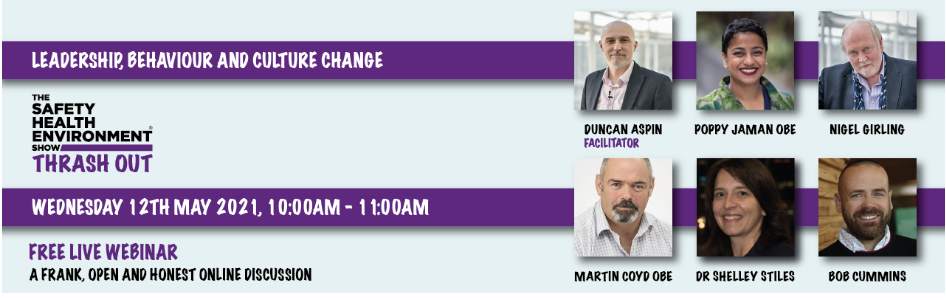
Dr Shelley Stiles, one of our Partner Directors, was recently asked to pose a question about leadership, culture and behaviour and the importance of these aspects as we emerge from the current stage of the pandemic. Here is Shelley’s view.
Since the beginning of the pandemic, it has been a challenging time for leaders and the health and safety profession. Not only is there a new and unknown high hazard (COVID) with the risk of transmission little understood (although this has improved massively since those early days); our world literally changed overnight. That includes the practical ways in which organisations and leaders develop affiliation, unity and identity. How do organisations build a positive, consistent health and safety culture with team members disparate across places of work – home, workplace, or working with hybrid arrangements between the two?
Numerous studies have identified the need for individuals to hold strong affiliation for higher levels of commitment and engagement that are necessary for a positive and mature health and safety culture. We often see visible leadership, leader-member engagement, values-based culture improvements promulgated as the ‘right things to be doing’. The usual ways in which leaders have been able to communicate with their teams has be affected. Take the traditional ‘Safety Tour’ where leaders would visit places of work, conduct a walkaround and engage directly with the workforce asking questions, seeking feedback and demonstrating visible commitment to health and safety.
Under COVID lockdown restrictions non-essential work was supposed to be undertaken from home. This puts the onus on the organisation to determine whether a Safety Tour is essential or not. Initially perhaps this could have been identified as one of the activities that is non-essential, but now, some 14 months since the start of the pandemic, is the visibility and engagement of leaders now deemed essential? Not only is there the legal interpretation that needs consideration but also the moral example a leader is giving by attending sites when the government advice is to minimise such interactions. There is a trade-off: being visible to support the teams working through challenging and unprecedented times, being seen to follow the national government mandates regards travel. This was summarised as ‘site versus the bedroom brigade’ in a recent study by Loughborough University (1.) There is no easy answer here and my reflection is that the response to this question has likely changed over the last 14 months.
Many of us turned to technology as our means of communication, investing many hours in back-to-back online meetings, learning how to ‘unmute’ before speaking in conversation, a greater awareness of ones working environment (the kitchen, spare bedroom, dining room table etc) and the limitations of this type of engagement. It has been reported that individuals who do not speak in the first 5 minutes of an online call are unlikely to speak at all! Studies have shown an increase in online communications increased the psychological safety of our teams, where leaders were able to demonstrate support, maintaining if not building relationships. However, leaders may not be able to reach out and engage with the entire workforce via this medium. And is it really the best medium for good engagement?
Regular communication and engagement with leaders, alongside authentic demonstrations of commitment to health and safety increase perceived levels of organisational support which in turn has positive impact on psychological safety (2.) Conversely passive leadership has a negative impact (3.) So, we know that leaders have to do something to be visible and engage with their teams but what should this look like moving forwards?
Some of the more effective leadership approaches I have observed during the pandemic are authentic, focusing on autonomy, trust and empathy. Showing you genuinely care about your team whilst being transparent about the challenges the organisation is facing. I have seen others who have taken a more controlling approach, micro-managing rather than empowering their teams, with a less positive impact. Going forwards, good may involve a combination of safety tours, online forums, 1-1 engagement, all of the tools that we have at our disposal to develop a culture of openness and support. Stronger affiliation and a sense of being part of the organisation, of identity and unity will develop increasing the psychological safety of the teams.
My final question to you all is, as we emerge from the current phase of the pandemic, and look ahead to the remainder of 2021 and beyond, what are we be encouraging our leaders to practically do to create a positive and mature health and safety culture?
1 Jones, W. Chow, V. and Gibb, A. (August 2020) Covid-19 and Construction: Early lessons for a new normal? Loughborough University.
2 Hofmann, D. A., and Morgeson, F. P. (1999). Safety-related behavior as a social exchange: The role of perceived organizational support and leader–member exchange. Journal of Applied Psychology, 84(2), 286–296.
3 Zohar, D. (2002) The effects of leadership dimensions, safety climate, and assigned priorities on minor injuries in work groups. Journal of Organisational Behaviour, Volume 23 Issue 1, 75-92.